Months of trying, normal periods, a normal husband’s report, and still no pregnancy. Sometimes the answer turns out to be a blocked tube. It sounds frightening; is laparoscopy for tube block necessary? It is also one of the problems that can actually be looked at directly, and often fixed in the same sitting.
Let’s know about fallopian tubes laparoscopy.
What the Tubes Do, and Why a Block Matters
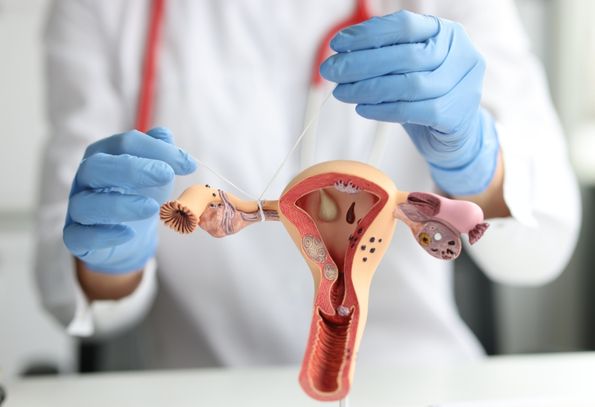
Each woman has two fallopian tubes, thin and soft, running from the womb out towards the ovaries. They are where the egg and sperm meet. After that, the tube gently moves the early embryo down into the womb, which takes a few days.
If a tube is blocked, the sperm can’t get through to the egg, or the fertilised egg can’t get back down. One blocked tube usually lowers the chances a bit. Both blocked, and natural pregnancy becomes very unlikely. There’s one more risk worth knowing about too. A tube that is partly damaged can trap the embryo inside it, and that is an ectopic pregnancy, which needs urgent care.
How Does a Tube Get Blocked in the First Place?
Most women have no idea anything is wrong. There’s no pain, nothing odd with periods. The block is found only when they start looking for the reason pregnancy isn’t happening.
The usual reasons we come across:
- An old pelvic infection, sometimes years back, that healed but left scarring inside or around the tube
- Endometriosis, which can glue the tubes and ovaries together with bands of tissue
- Earlier surgery in the tummy, like an appendix operation or a previous C-section
- A past ectopic pregnancy
- A swollen, fluid-filled tube called a hydrosalpinx (doctors just say “hydro” sometimes)
Quite often, honestly, no clear reason is found at all. And that’s alright. The treatment depends on what the tube looks like now, not so much on how it got there.
How Do Doctors Find Out If the Tubes Are Open?
The first test is usually an HSG. A dye goes in through the cervix and an X-ray shows whether it flows out through the tubes. It is quick, done without admission, and a bit crampy for a few minutes. Some places use a saline ultrasound instead.
These tests are good, but they have limits. Sometimes a tube simply goes into spasm during the test and looks blocked when it isn’t. And neither test can show scarring on the outside of the tube or small spots of endometriosis.
That’s where fallopian tubes laparoscopy comes in. It is the only way to actually see the tubes, the ovaries and everything around them with your own eyes, so to speak. Not every woman needs it. But if the HSG is unclear, if there is pain, or if endometriosis is suspected, your doctor may suggest going straight to it.
What Happens on the Day of a Fallopian Tubes Laparoscopy?
A fallopian tube laparoscopy is keyhole surgery. No big cut. Most women go home the same day or the next morning.
Before
A few blood tests, a check-up, and no food or water for some hours before. It is usually planned in the first half of your cycle, after periods finish.
During
You are fully asleep. A tiny cut is made in the belly button and a thin camera goes in. The tummy is filled with a little gas so the surgeon can see clearly. Then a coloured dye is passed in through the cervix. If it spills out of the end of the tube, that tube is open. If it doesn’t, the surgeon can see exactly where it stops. The whole thing takes somewhere between half an hour and an hour or so, longer if something needs fixing.
After
You wake up with two or three small cuts covered by plasters. A bit sleepy. A bit sore. That’s about it.
Can Laparoscopy for Tube Block Actually Open the Tubes?
Sometimes, yes. This is the best part of laparoscopy for tube block, because the diagnosis and the treatment can happen together, while you are already asleep.
If the tube is stuck down by bands of scar tissue, those can be carefully cut free. If the far end of the tube is closed, a new opening can sometimes be made. Endometriosis patches can be removed or burnt off in the same go. Cysts on the ovary can be dealt with too.
But we’ll be honest with you. Not every tube can be saved. If a tube is badly damaged, or swollen with fluid, it may do more harm than good, because that fluid can leak back into the womb and make IVF less likely to work. In that case the surgeon may close or remove that tube, which actually improves the chances later. For women with both tubes badly damaged, or who are a little older and short on time, IVF is often the quicker road. It skips the tubes completely.
Recovery, Honestly
Most women are surprised how quickly they are up and about. A few things are normal in the first few days:
- Pain in the shoulder, which sounds odd but comes from the leftover gas and fades in a day or two
- Some bloating and a sore tummy
- Light spotting, from the dye test
- Feeling tired, more than you’d expect for such small cuts
Light housework is fine after a few days. Desk jobs, about a week, give or take. Lifting heavy buckets or bags of atta should wait a little longer. Fever, pain that keeps getting worse, or a red, leaking cut, call us straight away.
When Can You Try for a Baby, and Where to Start?
Laparoscopy surgery in Prayagraj can help address certain fertility concerns, including blocked fallopian tubes. While some couples may start trying to conceive from the next menstrual cycle, others may need to wait as advised by their doctor. If pregnancy does not occur within a few months, options such as IUI or IVF may be discussed. At Dr. Preeti Hospital, multispeciality hospital in Prayagraj, couples can consult a specialist to understand their treatment options and plan the next steps towards parenthood.