A scan report says “cyst”, and the worry starts straight away. Is it PCOS? Will it stop a pregnancy? Does it need an operation? These two conditions get mixed up all the time, and they really are not the same thing. Here is the plain version.
First Things First, What Are Ovarian Cysts?
Ovarian cysts are small sacs, usually filled with fluid, that sit on or inside an ovary. A lot of women get one at some point in life and never find out, because it causes no trouble and quietly disappears.
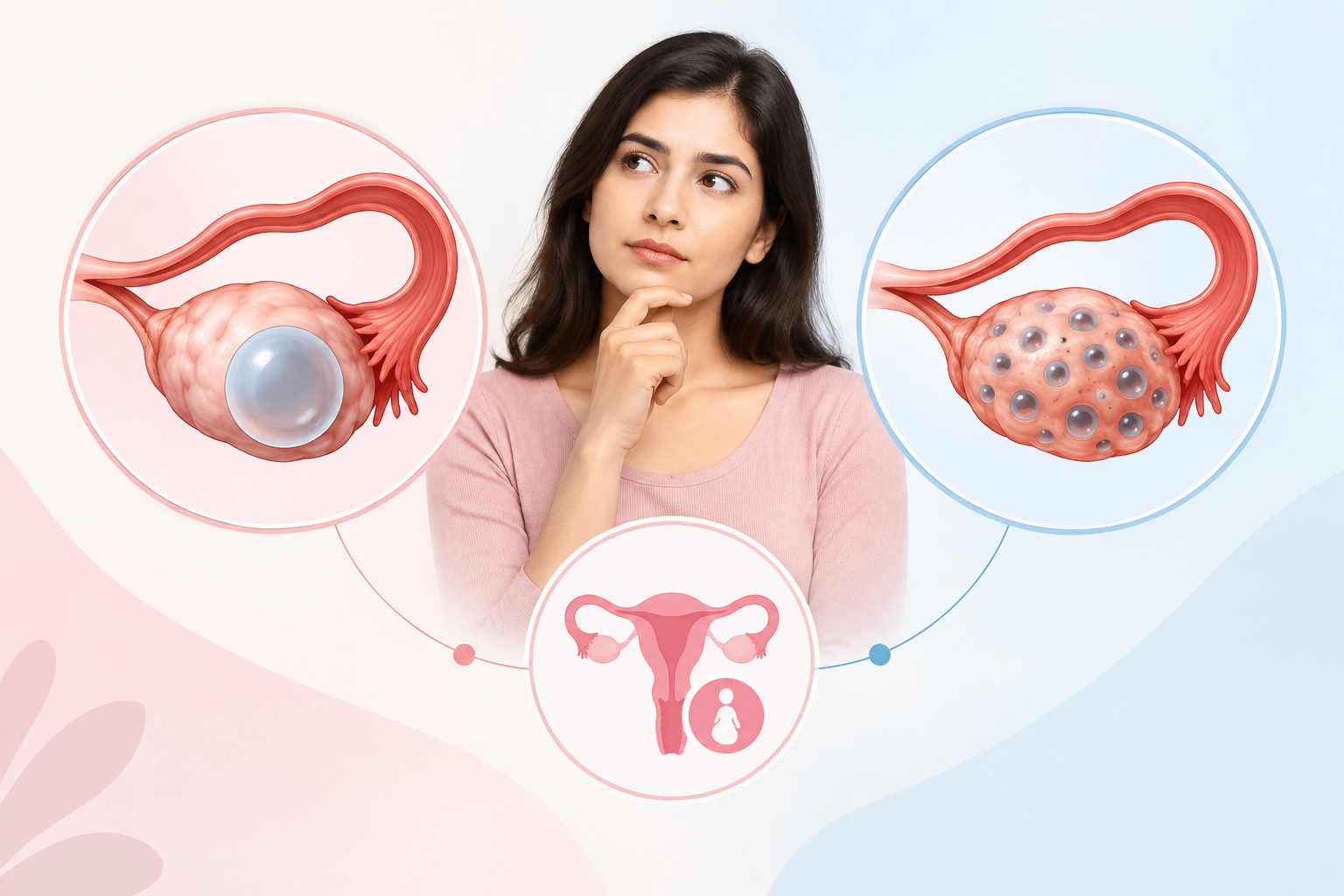
The most common kind is called a functional cyst. Every month your ovary grows a tiny follicle that holds an egg. Normally it bursts open, lets the egg out and shrinks back. Sometimes it doesn’t burst, or it closes up again afterwards, and fluid collects inside. That’s a functional cyst. Most of them fade within a few cycles, often without any medicine at all.
There are other kinds too. A chocolate cyst, or endometrioma, comes from endometriosis and is filled with old blood. Dermoid cysts and a few others are less common and behave differently. The type matters far more than the size printed on your report.
Why Cyst Formed in Ovary? The Question Every Woman Asks
Almost every woman who walks into our Jhunsi clinic with a report in hand wants to know one thing: why does a cyst form in the ovary when she eats properly and feels perfectly fine. Fair question. Mostly, the answer is that you did.
Some common reasons we see:
- A normal monthly cycle that simply didn’t finish the way it was meant to
- Hormone ups and downs, which can come with stress, weight change or thyroid trouble
- Endometriosis, where tissue like the womb lining grows where it shouldn’t and forms a cyst on the ovary
- Early pregnancy, as a small cyst supports things for the first few weeks
- Fertility medicines, sometimes, since they push the ovaries harder than usual
So if you have been blaming yourself, please stop. Knowing exactly why cyst formed in ovary rarely changes the plan much anyway. What type it is, that changes the plan.
What About PCOS? Honestly, It Isn't Really a Cyst Problem
PCOS, or polycystic ovary syndrome (many people here still call it PCOD), is a hormone condition. The name makes it sound like a disease of cysts. It isn’t, not really.
In PCOS the ovaries hold lots of small follicles that start growing and then just stop halfway. None of them gets big enough to release an egg. On a scan they can look like a little string of beads around the edge of the ovary. These are not true cysts in the way a single functional cyst is.
What PCOS actually brings is a mix of things: periods that come late or skip months, acne, extra facial hair, weight that is hard to shift, and sometimes dark patches on the neck. Some women have most of these. Some have only one or two.
Ovarian Cysts vs PCOS, the Real Difference
Think of it like this. A cyst is one thing in one place. PCOS is a pattern that affects the whole hormone system.
How many are there?
Usually one cyst, sometimes two. With PCOS it’s many tiny follicles, often on both sides.
What happens to periods?
A simple cyst rarely changes your cycle much. PCOS very often does.
Does it go away?
Most functional ovarian cysts go away on their own. PCOS doesn’t go away, but it can be managed well. Quite well, in fact.
How Can Each One Affect Fertility?
This is the part couples care about most, so let’s go slowly.
Simple cysts
A functional cyst on its own almost never stops a pregnancy. Plenty of women conceive with one sitting there. We often just repeat the scan after a cycle or two and watch it shrink.
Chocolate cysts
Endometriomas are a different matter. The endometriosis behind them can affect egg supply and make the pelvis a less friendly place for conception. Even then, many women do get pregnant. Surgery on these cysts needs care, because taking out too much healthy ovary can lower the egg count, so the decision is never rushed.
PCOS
With PCOS the real issue is ovulation. If no egg is released, pregnancy can’t happen that month. The good news is that this is one of the most treatable reasons for trouble conceiving. Losing even a little weight brings periods back for some women. Others need tablets to help them ovulate, and a few need more support than that. Our team for infertility treatment in Prayagraj usually starts with the simplest step and only moves up if it’s needed.
Do Ovarian Cysts Need Surgery Before Trying for a Baby?
Not always. Actually, not usually. Most ovarian cysts found during a fertility check are left alone and simply watched.
Surgery comes into the picture if the cyst keeps growing, stays for months, causes a lot of pain, or looks unusual on the scan. When it is needed, it’s mostly done by laparoscopy, the keyhole method, and the aim is to remove the cyst while saving as much of the ovary as possible. Recovery tends to be quick. A few days off work, sometimes a week.
When Is It Time to See a Doctor?
Sudden, severe pain on one side of the tummy, especially with vomiting or fainting, needs hospital emergency the same day. A cyst can twist the ovary, and that can’t wait.
For everything else, book a visit if your periods skip months, if you have been trying for a baby for about a year without luck (or around six months if you are past 35), or if a scan has shown a cyst and nobody has explained it to you properly. A chat with a gynecologist in Prayagraj at our hospital can sort out which one you have and what, if anything, needs doing. No pressure. Just answers.